A Case Study of a Communication between a City and a Human in Urban Regeneration Process
Hong Seuk-pyou
Department of Design (graduate program)
Department of Design (graduate program)
I visited Nantes, the city the urban regeneration project was underway, to investigate how a city communicates with people. I considered the specificity and historicity of the region to look into practical issues and concerns for improvement. I aim to use this research outcome as the data for dealing with urban regeneration issues in Korea.
This research focuses on the keywords of cities and signs and collects them to think about their roles and meanings.
I. Objective
By researching and collecting data on what communications between a city and people look like, I will attempt to present a new light on concerns Korea faces regarding urban regeneration. I collected signs in Nantes based on the research keywords and thought about their roles and meanings.
II. Extent of the Research
The research bases on the tour I took along the green line extending from the old town to the Island of Nantes.
III. Research Methods
I walked along the green line and collected the images of the city by photographing. I also conducted interviews with the locals.
IV. Results
1. Compared to the old town full of abundant historical resources, the new city – the Island of Nantes – had few things to experience. It caused a sense of discontinuity between the two regions when I walked along the green line.
2. A mechanical elephant was quite efficient to attract the floating population. However, there was nothing more to experience beyond it to maintain the visitors’ interest level.
3. The Island of Nantes needs more active means of communication compared to the old town. The examples could be green chairs where citizens can sit and rest, green circles that allow people to gather in the open space, green tracks to let them jog, etc.
○ Days 3-4: Collecting the images of the city
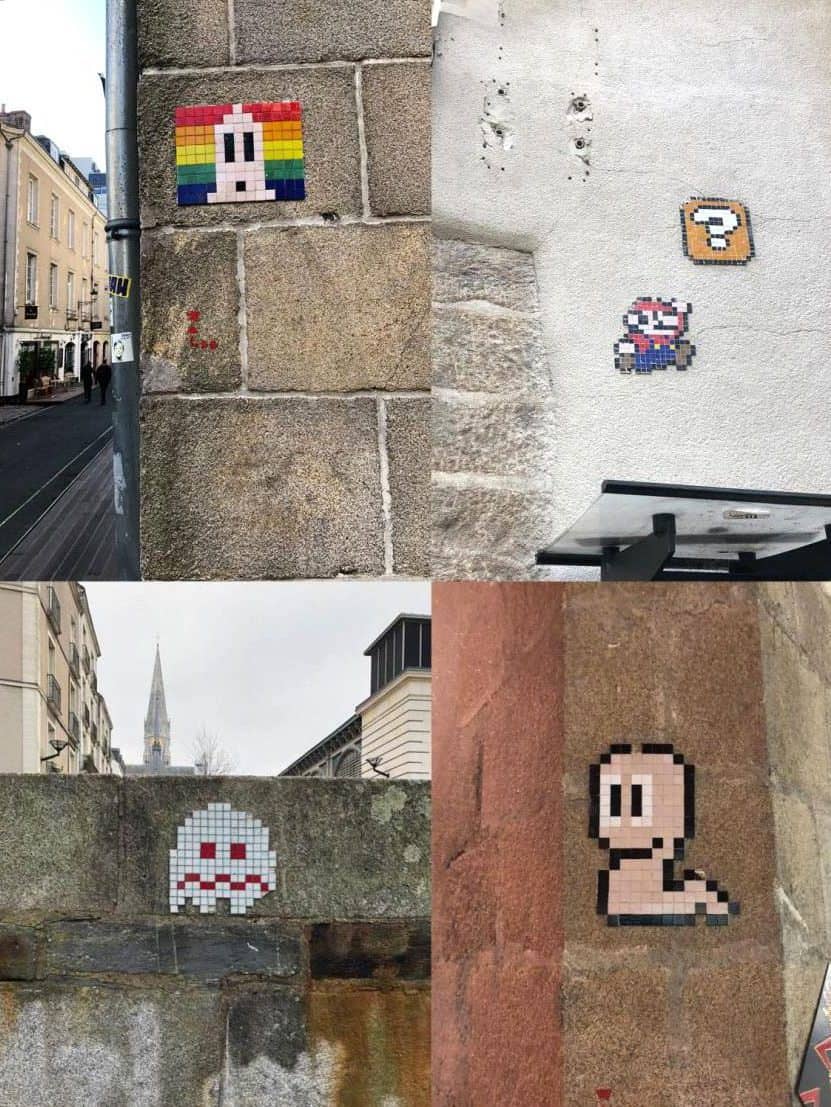
I found new forms of images while collecting the city symbols.
Interestingly, the moment aroused my inner child. Later, even when my teammates and I divided into action for individual research, we took photos of “space invaders,” the symbols, and shared them around whenever any one of us discovered them. I felt that signs like space invaders enriched the experiences in a city, serving as visual variables.
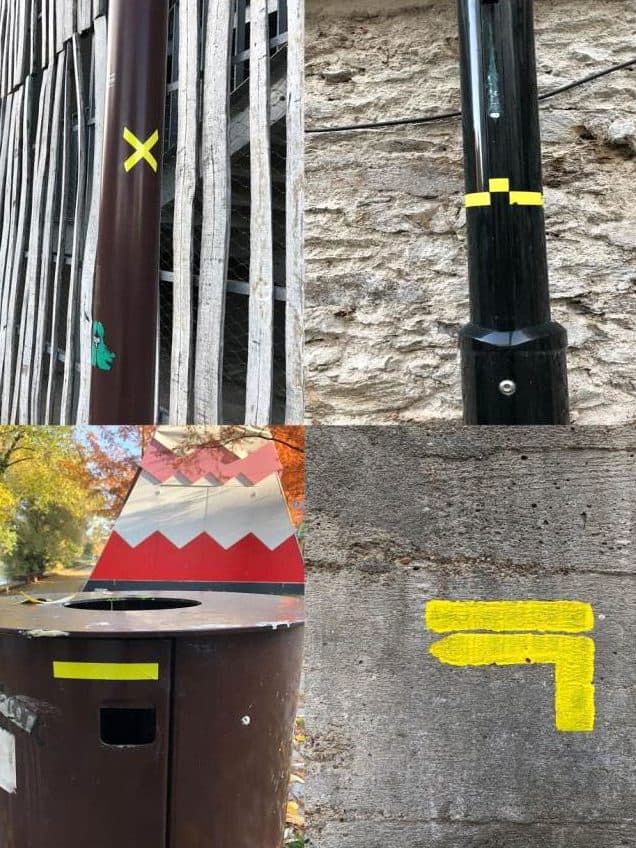
○ I found signs that caught my eyes as I walked along the green line. I learned from the interviews I had on the green line that urban planning workers communicated through these signs. A sign [x] meant “Do not draw the green line in the front,” and another sign [-] indicated “Draw the line straight ahead.” Besides, [ㄱ] was a symbol referring “to draw a line that curves to the left.” Although these signs were supposed to be communication tools between workers, I still found them eye-catching and visually quite attractive.
Also, I was able to hear the real opinions of the locals from their interviews. Few were interested in the green line. And realistically, it seemed to be a pain point of any urban regeneration projects. The interviews made me think about the roles of urban revival as something not just for tourists but also for the residents.
For the locals, Nantes is already a familiar space. They needed more places to relax, interact, or enjoy performances together rather than somewhere entirely new to explore.
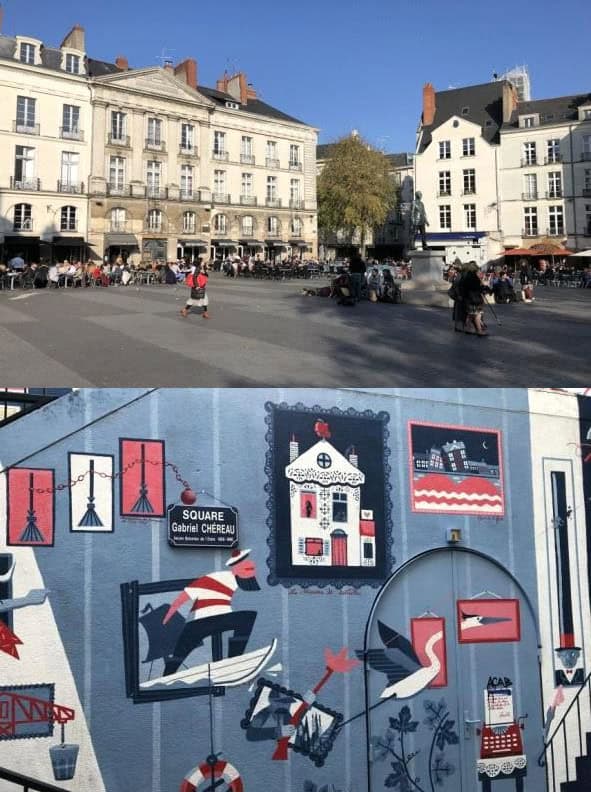
In the old town, there were many places where anyone could have a cup of coffee and take a break, watching people on the streets, along the green line. When I walked along the green line in the old town, I felt the experiences here were more connected than in the Island of Nantes. Watching some old buildings was a positive experience that did not get me bored while walking along the green line.
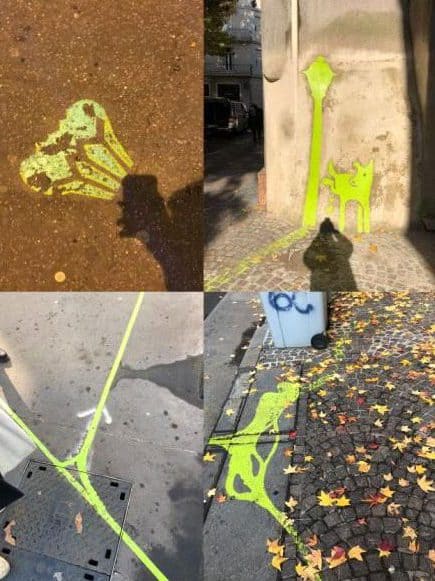
On the other hand, I discovered some unique examples of the green line too. From these variables, I found some room for improving the pain point existing in the green line.
Additionally, I also found some examples of variations of the original design rules.
도시재생과정에 있는 도시와 사람간의 커뮤니케이션 사례 연구
홍석표
미술원 디자인과 전문사
미술원 디자인과 전문사
도시재생사업이 진행 중인 낭트를 방문하여 도시와 사람 간의 커뮤니케이션이 이루어지는 부분을 지역의 특수성과 역사성을 고려하여 조사하고 체험을 통해 실질적인 문제점과 보완할 점을 조사한다. 이를 통해 한국의 도시재생 문제를 바라볼 때 유용한 자료로 사용할 수 있도록 한다. 도시와 기호라는 키워드를 통해 도시에서의 기호들을 수집하고 기호들의 역할과 의미들을 생각해본다.
I. 연구의 목적 및 중요성
도시와 사람 간의 커뮤니케이션의 방법에 대해 자료를 수집하고 연구함으로써 한국에서의 도시재생 문제에 대해 새로운 시각을 제시할 수 있도록 한다. 도시의 기호 키워드를 통해 도시에서의 기호들을 수집하고 기호들의 역할과 의미들을 생각해본다.
II. 연구의 내용 및 범위
구시가지에서부터 ‘일 드 낭트’까지 이어진 그린라인 투어
III. 연구 방법
그린라인을 직접 걸으며 사진을 통해 이미지를 수집하고, 지역주민과의 인터뷰를 통해 연구 진행
IV. 연구 결과
1. 역사적으로 볼 것이 많은 구시가지에 비해 신시가지(일 드 낭트)는 비교적 볼 것이 풍부하지 않았기 때문에 그린라인을 따라 걸어갈 때 경험이 끊기는 듯한 인상을 받았음.
2. 유동인구를 끌어들이는 방법으로 ‘기계 코끼리’는 상당히 효과적이었으나 그 이후에 연결될 수 있는 경험이 부족
3. 일 드 낭트에서는 끊어진 경험들을 연결할 수 있도록 ‘구시가지’에 비해 좀 더 적극적인 커뮤니케이션 방법이 필요하다고 판단 (ex.시민들이 쉴 수 있는 그린 의자, 공터에서 사람들이 모일 수 있도록 하는 그린 서클, 달리기 시합을 할 수 있는 그린 트랙…)
○ 3-4일 : 도시의 이미지 수집
도시의 기호들을 수집하던 중 새로운 형태의 이미지를 발견하였다.
순간 동심으로 돌아간 기분을 느낄 수 있었다. 이후 팀원들이 나뉘어 활동할 때에도 ‘인베이더’가 보이면 사진을 찍어 보내주었다. 이러한 시각적 변수 같은 기호들은 도시를 보다 풍성하게 해줄 수 있는 것 같다.
○ 5일 : 그린라인 투어 시작
또한, 인터뷰를 통해 실제 주민들의 목소리를 들을 수 있었다. 그린라인에 대한 관심이 있는 이들은 적어 보였다. 도시재생사업에 있어 실질적인 pain point가 될 수 있을 것 같다고 생각하였다. 관광객만을 고려한 프로젝트가 아닌 실제 거주하고 있는 거주민들과의 관계와 역할에 대해 고민할 수 있었다. 그들에게는 낭트는 이미 친숙한 공간이고 그곳에서 새로운 공간을 탐색하기보다 쉬어가는 곳이라든지 혹은 함께 공연을 보고 참여할 수 있는 새로운 공간이 더 필요해 보였다.
구시가지에서는 그린라인을 따라 걸어가는 중간에 커피를 한잔 하고 갈 수 있는 곳이나 잠시 쉬어서 사람들을 구경할 수 있는 공간들이 있었다. 그린라인을 따라 걸어갈 때 신시가지보다 경험이 연결되어 있다는 느낌을 받을 수 있었다. 비교적 오래된 건물들은 그린라인을 따라 걸을 때 눈을 심심하게 하지 않았고 긍정적인 부분이 있었다.
변형된 그린라인의 사례를 발견할 수 있었다. 변수와 같은 이러한 사례들에서 기존의 그린라인이 가지고 있는 pain point를 개선할 수 있는 여지를 발견하였다.
이 외에도 기존의 디자인 규칙들을 가지고 자신들의 방법으로 활용한 사례들을 찾아볼 수 있었다.